THE REFEREE
1. Shouldn't started a racial provocation by saying " I dont like your Fijians to be your captain, i'll prefer a malay guy".
2. Should be consistent in the decision making through out the game.
3. Should always look at the touch judge for consultation.
4. Shouldn't give cards when players are asking.
5. Touch judge should have be more forceful in the decision making if he sees the referee is making to many mistakes.
6. Should not provoke an angry players that have just been sin binned for no reasons.
7. Should just get away when things started to look like they're going to get ugly for him.
PUTRAJAYA TEAM
1. Should have controlled their anxiety and control others on the team.
2. Players should have just done their job playing and leave the argument for the management team.
SABAH TEAM
1. Should not have involve in the quarrel between PUTRAJAYA TEAM and the referee.
MRU(MALAYSIAN RUGBY UNION)
1. Should never let unqualified referee to officiate the highest level match is Malaysia, Piala Agong.
Showing posts with label rugby. Show all posts
Showing posts with label rugby. Show all posts
Friday, December 4, 2009

Thursday, December 3, 2009
Rage At Field as Putrajaya lost to Sabah in the Cup Semi-Final of the Agong's Cup...
Thursday, Politeknik Shah Alam - 2 semi final match have taken place in the Agong's Cup semi final. The first match is for the plate semi-final which sees Negeri Sembilan demolished Perlis to go through the final. The score? i dont really notice, but Negeri Sembilan won quite comfortable. The best story is about the cup semi final between Sabah and Putrajaya. The match started roughly around 5.00pm. Putrajaya is powered by most from ASAS RC and few from Bangi Hunterz. With 3 Fijians on their side, Atunaisa Toga, Apisai Nabo and the captain, Timoci Nacokula. Sabah on the other hand is powered by mostly Sandakan Eagles players. They are also using some foreign players from Samoa, Fiji and using the services of an U-21 Junior All Blacks players. The weather looks really windy and looks like it is about to rain. Whatever the weather condition is the match still started and then the kickoff whistle blowed. At the very first 5minutes of the first half, highly determined Putrajaya give a lot of pressure to Sabah and manage to score a try. Unfortunately the try is disallowed by the referee due to a forward pass by Atunaisa Toga to Timmy Nacokula. The unclear decision left the Putrajaya team frustrated. Right after the try was disallowed, heavy rain started to pour. The match had the be stopped as there are also lightning seen above the play ground. The team had to wait for the rain to stop and waited for the officials to decide on the match. After around 1/2 hour, the rain started to cool down and the referee decided to start the match. Due to the bad condition on the field, the referee direct for an uncontested scrum through out the game(stupid isnt it? never heard of it before, the whole game?) Putrajaya and Sabah continue to play their rugby and 10minutes after the match re-begin, Putrajaya manage to score a try from the forwards. Unfortunately, the conversion was unsuccessful and the score only 5 - 0. The match was at an even with both team having their own pattern play. Before the ned of half time, Sabah manage to narrow the gap with a successfully converted penalty by the Junior All Blacks flyhalf. End of first half, Putrajaya 5 - Sabah 3. The begin of 2nd half is quite the same with the first half, Putrajaya again get to widen the gap by a try at the corner by their winger. making it 10 -3. After the try, the referee than started to make a lot of bad calls in favor of the Sabah team. Both Putrajaya Fijians get sin binned on different occasion by the ref. Putrajaya are not happy with the call as it is inconsistent, and a lot of bad judgement from the touch judge. Almost at the end of time, Sabah give a penalty in front of their own 22 line and is taken by Putrajaya's scrum half. Things got worse for Putrajaya as the their scrum half, didnt converted the easy penalty. Sabah then begin to counter back but Putrajaya defending is supreb and they had to play back at their halves. The interesting incident happen after this...Sabah fly half kicked the ball to Putrajaya winger in the 22 line. Mark is call by the winger and 2 Sabah players go on tackle the winger after the mark was called. Sabah then pick up an easy try from the incident.
Mark was called and the touch judge heard it but didnt consult the referee. The referee should have heard it also as all the players inside the field and the substitute and spectators also heard it. Putrajaya pack leader and hooker then argue the clearly wrong decision with the ref and got carded. Putrajaya pack leader got sin binned and the hooker got red carded. The referee then said to a player that he didnt like the Putrajaya team captain as he is a Fijians and prefer a local to captained a team. That is so racism of the referee ayte? It is quite a scenery before the final whistle as the game stopped and all the players, spectators and managers are full of adrenalin rush and anger. Right after the referee blows the finals whistle, lot of people attack the referee. I dont have any right words to describe the incident, but just take a sneak preview of what happen on my posted youtube video. Maybe you'll get the idea of what happen, but just for a reminder on the video is when the incident is cooling off. Just imagine what happened before that?
Tuesday, December 1, 2009
PUTRAJAYA cruise through the semi-finals of the Agongs Cup...
1 December 2009, Malaysia - teken place at Politeknik Shah Alam the quarter finals of The Agong's Cup see Putrajaya versus Perlis in the noon fixture and Negeri Sembilan versus Sabah in the evening fixture.

Start approximately at 3.30pm, the game between Putrajaya and Sabah kick off. Putrajay with the advantage of 2 foreign players on the field manage to score an early try from a scarppy scrum and scrum half, Apek took the advantage and score the first try. Perlis began to pressure as they are left behind and conceded lot of penalty. Winning lot of penalties, Putrajaya took advantages and score another penalty kick right infront of the post making the score 8 - 0. Perlis Flyhalf, whos game plan is tactical kicking all through out the game didnt come to a good end when Timoci Nacokula strike back and pass the ball to Luncai who scores the second a converted try for Putrajaya making it 15 - 0. Putrajay who seems really eager to score more tries than make a breakthrough again from the captain Timoci Nacokula through the center and pass the ball to Faizol Zainal Abidin to score a converted try making it 22 - 0. On half time, Abg Man Cina, the coach gives a few tips to the players and ask them to work harder and just stick to the game plan. 2nd half started with Perlis making a substitute bringing in their coach cum player who is a senior ex-national player, Wan Chan to the team. The arrival of Wan Chan gives lot of moral motivation and the Perlis team looks more focus than they did before. With the high determination and spirits, Perlis manage to fight back with a try from the winger and a success conversion make it 22 -7. Putrajaya are more fireful than ever started to play their game back, substituting Atunisia Toga with Apisai Nabo is a great move by coach Man Cina. Atunasia score from the middle of the field and successfully converted his own try making it 29 - 7. The Perlis team who is under a lot of pressure then again doing lot of mistakes and giving more penalty giving Putrajaya the chance to add points to the scoreboard. Atunisia Toga successful penalty make it 32 - 7 for Putrajaya. But at the end of the game, Putrajaya fatigueness seems terrible as they play a lot of dangerous football. 2 players are Sin Bin and 1 is red carded. But Putrajaya manage to hold on to lead until the end of the game. Final score, Putrajaya 32 Perlis 7.
In the other quarter finals, Negeri Sembilan meet up with the mighty Sabah. Their game is so tight and hard as both sides forwards hits and run the ball through out the game. The brilliance of Sabah No.10 imports, make it a worthy game to watch. Sabah won the game and will meet Putrajaya in the Cup semi-final next Thursday. This is going to be a big hard game for both team as both emphasis on the forward play and lot of hitting and setplay. Will see you guys then...

Start approximately at 3.30pm, the game between Putrajaya and Sabah kick off. Putrajay with the advantage of 2 foreign players on the field manage to score an early try from a scarppy scrum and scrum half, Apek took the advantage and score the first try. Perlis began to pressure as they are left behind and conceded lot of penalty. Winning lot of penalties, Putrajaya took advantages and score another penalty kick right infront of the post making the score 8 - 0. Perlis Flyhalf, whos game plan is tactical kicking all through out the game didnt come to a good end when Timoci Nacokula strike back and pass the ball to Luncai who scores the second a converted try for Putrajaya making it 15 - 0. Putrajay who seems really eager to score more tries than make a breakthrough again from the captain Timoci Nacokula through the center and pass the ball to Faizol Zainal Abidin to score a converted try making it 22 - 0. On half time, Abg Man Cina, the coach gives a few tips to the players and ask them to work harder and just stick to the game plan. 2nd half started with Perlis making a substitute bringing in their coach cum player who is a senior ex-national player, Wan Chan to the team. The arrival of Wan Chan gives lot of moral motivation and the Perlis team looks more focus than they did before. With the high determination and spirits, Perlis manage to fight back with a try from the winger and a success conversion make it 22 -7. Putrajaya are more fireful than ever started to play their game back, substituting Atunisia Toga with Apisai Nabo is a great move by coach Man Cina. Atunasia score from the middle of the field and successfully converted his own try making it 29 - 7. The Perlis team who is under a lot of pressure then again doing lot of mistakes and giving more penalty giving Putrajaya the chance to add points to the scoreboard. Atunisia Toga successful penalty make it 32 - 7 for Putrajaya. But at the end of the game, Putrajaya fatigueness seems terrible as they play a lot of dangerous football. 2 players are Sin Bin and 1 is red carded. But Putrajaya manage to hold on to lead until the end of the game. Final score, Putrajaya 32 Perlis 7.
In the other quarter finals, Negeri Sembilan meet up with the mighty Sabah. Their game is so tight and hard as both sides forwards hits and run the ball through out the game. The brilliance of Sabah No.10 imports, make it a worthy game to watch. Sabah won the game and will meet Putrajaya in the Cup semi-final next Thursday. This is going to be a big hard game for both team as both emphasis on the forward play and lot of hitting and setplay. Will see you guys then...
Saturday, November 28, 2009
HISTORY OF RUGBY (Chapter 6)

1948–86
In 1948 the worth of a drop goal was reduced from 4 points to 3 points.
In 1949, the Australian Rugby Union was formed and took over the administration of the game in Australia from the New South Wales Rugby Union.
Long after William Webb Ellis had become engraved as a legend in the history of rugby union, his grave was finally located in October 1959.
In 1971 Scotland appointed Bill Dickinson as their head coach, after years of avoidance, as it was their belief that rugby should remain an amateur sport. The 1971 Springbok tour to Australia was famous for its political protests against South Africa's apartheid system. The 1970s were a golden era for Wales with the team capturing five Five Nations titles and dominating the Lions selections throughout the decade. In the middle of the decade, after overseeing the rise in popularity of rugby union in the United States, members bodies met in Chicago in 1975 and formed the United States of America Rugby Football Union, today known as USA Rugby.
The 1981 Springbok Tour to New Zealand was also marked by political protests and is still referred to by New Zealanders as The Tour. The tour divided New Zealand society and rugby lost some of its prestige, which was not restored until New Zealand won the inaugural 1987 Rugby World Cup. In 1983, the WRFU (Women's Rugby Football Union) was formed, with 12 inaugural clubs, the body being responsible for women's rugby in England, Wales, Scotland and Ireland. In 1984 the Wallabies completed their first grand slam, defeating all four home nations, and announcing their emergence as a power in world rugby.
The Rugby World Cup
The first Rugby World Cup was played in 1987. New Zealand hosted the tournament, with some games, including both semi-finals, being played in Australia. The All Blacks defeated France in the final to record their only World Cup success.
In 1991, England hosted the second tournament, losing to Australia in the final.
The World Cup of 1995 proved to be a turning point for the game. The competition was held in South Africa, newly readmitted from international exile. Rugby's first superstar emerged when giant wing Jonah Lomu scored four tries for the All Blacks against England. South Africa, who had not been allowed to compete in the first two tournaments, won the final, beating the All Blacks 15-12, the winning score coming from a drop-goal by Joel Stransky. South African President Nelson Mandela, dressed in a Springbok jersey (long a symbol of apartheid) bearing the name and number (6) of South Africa's captain Francois Pienaar, handed him the William Webb Ellis Trophy.
The 1999 Rugby World Cup was held in Wales and was won by Australia, who defeated France in the final after the latter had come from behind to record a shock win against tournament favourites, the All Blacks, at the semi-final stage.
In 2003, Australia hosted the tournament and reached the final for the third time. In a closely-fought game, which went into extra time, Australia narrowly lost to England, thanks to a last-minute drop goal by Jonny Wilkinson.
Though France was the host nation for the 2007 Rugby World Cup, several games were played in Edinburgh and Cardiff, and France found itself playing its quarter-final in Wales, against the All Blacks, who had started the tournament as odds-on favourites. In a repeat of 1999, France gained a shock win, consigning the favourites to their worst result in World Cup history. France went on to lose against England at the semi-final stage. England, in turn, lost in the final to the Springboks, who equalled Australia's record of two World Cup wins. The breakthrough team in that competition was Argentina, which had previously been viewed as a strong team on an international scale, but perhaps not quite to the level of the traditional world powers. The Pumas began their coming-out party with a narrow win over France in the opener, and also defeated Ireland to finish atop their pool. They would lose in the semifinals to South Africa, but rebounded with a comprehensive win over France in the third-place game. This result led to calls to include the Pumas in one of the major hemispheric national team competitions (the Six Nations or Tri Nations); ultimately, it was decided that the Pumas would be steered toward a future place in the Tri Nations.

The professional era
On 26 August 1995 the International Rugby Board declared rugby union an "open" game and thus removed all restrictions on payments or benefits to those connected with the game. It did this because of a committee conclusion that to do so was the only way to end the hypocrisy of shamateurism and to keep control of rugby union. The threat to rugby union was especially large in countries where rugby league had a significant following. In particular, the Australian Super League competition was threatening to entice players to rugby league from rugby union (which was still amateur) with large salaries.
SANZAR was formed in 1995 by the New Zealand, Australian and South African Rugby Unions to try to counter the Super League threat.[12] SANZAR proposed a provincial competition with teams from all three countries; this competition became the Super 12 and later the Super 14. Their proposals also included an annual competition between each country's Test teams, the Tri Nations Series. They were eventually able to get backing for the competition from Rupert Murdoch's News Corporation, with a contract totaling $550 million (US) for ten years of exclusive TV and radio broadcasting rights. The deal was signed during the 1995 Rugby World Cup and revealed at a press conference on the eve of World Cup final.
SANZAR's proposals were however under serious threat from a Sydney-based group called the World Rugby Competition (WRC). WRC was formed by lawyer Geoff Levy and former Wallaby Ross Turnbull; both wanted a professional worldwide rugby competition funded by Kerry Packer.At one point the WRC had a majority of the All Blacks and Wallaby teams signed up to their competition. In addition to this the Springboks had signed the WRC contracts but had decided not to hand them over. With the three national Unions struggling to sign up their test players, the WRC hit problems when the South African players, recently crowned World Champions, decided not to hand over the WRC contracts and signed up with the South African Rugby Union:the players had been told they would never play for their country again if they committed to WRC.Most of the All Blacks then followed their Springbok counterparts by signing with their Union. The Australians, realising that without the New Zealanders and South Africans WRC's proposal could not succeed, relented and signed for the Australian Rugby Union.
The Heineken Cup was formed in 1995 as a competition for 12 European clubs. Today the competition includes teams from England, France, Ireland, Italy, Scotland and Wales. The century-old competition for the top European rugby nations became the Six Nations Championship in 2000 with the addition of Italy.
The key benefit for rugby union was that professionalism would eliminate the constant defection of union players who were attracted to the money of rugby league. The rugby union authorities of the time also hoped that as players could now play in either code, in the long term most of the sponsorship and interest would gravitate away from league to the more international game of union. However, rugby union has not managed to lure away more than a handful of elite players from rugby league, as the two codes have become quite different over the decades of separation in both culture and in aspects of play. The preferred body type and skill sets of players differ, especially in the play of the forwards. With access to players of different types, some more suited to one code and some to the other, some English rugby union clubs such as Harlequins have even formed rugby league teams which play in the premier rugby league competitions. In some countries rugby union's administration and structure have not developed along with its professionalism. In Australia the constant flow of rugby union juniors to rugby league clubs has slowed, but Australian rugby union has failed to successfully promote a club or franchise league below the elite level. With professional club games every weekend, Australian rugby league has maintained its dominance.
The many smaller unions across the globe have struggled (both financially and in playing terms) to compete with the major nations since the start of the open era. In England whilst some teams flourished in the professional era others such as Richmond, Wakefield, Orrell, Waterloo and London Scottish found the going much harder and have either folded or dropped down the leagues.
Alterations to the laws of rugby union were trialled by students of Stellenbosch University in South Africa in 2006, and have been adopted in competitions in Scotland and Australia since 2007, though only a few of the rules have been universally adopted. The law variations are an attempt to make rugby union easier to understand by referees, fans and players, but the laws are controversial and are far from being endorsed by all members of these groups
Scoring
The scoring system used in rugby has changed many times over the years. In the original games scoring a "touch down" allowed the team to "try" a kick at goal. This is the derivation of the word "try" to describe a touch down in Rugby Union. Prior to 1890 each of the Home Unions had their own point scoring systems. A try scored in Scotland was worth 2 points whilst a try scored in England was worth 1 point. One of the first tasks undertaken by the International Rugby Football Board, formed in 1890, was to introduce a standard point scoring system. One point was awarded for a try, two points for a successful kick at goal after scoring a try (a conversion) and three points for a dropped goal or for a penalty goal. Most of the changes have been to increase the value of tries compared to goals (conversions, penalties, dropped-goals, and goals from mark) in order to promote positive, attacking play.
Timeline of the foundation of national rugby unions
The first national rugby union was the Rugby Football Union, founded in England in 1871. This was followed over the next decade by the Scottish, Irish and Welsh Rugby Unions. In Australia, the Southern Rugby Union (later the New South Wales Rugby Union) and the Northern Rugby Union (later the Queensland Rugby Union) were formed in 1874 and 1883 respectively, before eventually helping form the Australian Rugby Union in 1949. Both South Africa and New Zealand formed their Unions before the end of the 19th century. The white South African Rugby Board merged with the non-racial South African Rugby Union in 1992 following the fall of apartheid. The other traditional rugby power, France, formed the French Rugby Federation in 1919.
Friday, November 27, 2009
HISTORY OF RUGBY (Chapter 5)

Summer Olympics
Pierre de Coubertin, the revivor of the modern Olympics, introduced rugby union to the Summer Olympics at the 1900 games in Paris. Coubertin had previous associations with the game, refereeing the first French domestic championship as well as France’s first international. France, the German Empire and Great Britain all entered teams in the 1900 games. France won gold defeating both opponents. The rugby event drew the largest crowd at that particular games. Rugby was next played at the 1908 games in London. A Wallaby team, on tour in the United Kingdom, took part in the event, winning the gold, defeating Great Britain. The United States won the next event, at the 1920 Summer Olympics, defeating the French. The Americans repeated their achievement at the 1924 Summer Olympics in Paris, again defeating France in a tournament marred by controversies surrounding the rivalry between the two teams. Though rugby had attracted bigger crowds than the track and field events in 1924, it was dropped from next Games and has not been included since.
Centenary of rugby
As 1923 approached, there were discussions of a combined England and Wales XV playing a Scottish-Irish team in celebration of when William Webb Ellis picked up the football and ran with it in 1823. The planned game was controversial in that there was a disagreement over whether it should be held at Rugby School, or be played at Twickenham, where an obviously larger crowd could witness the match. In the end, the match was taken to Rugby School
World War I
The Five Nations Championship was suspended in 1915 and was not resumed until 1920. One hundred and thirty-three international players were killed during the conflict. The Queensland Rugby Union was disbanded after the war and was not reformed until 1929; NSW took responsibility for rugby union in Australia until the formation of the ARU in 1949.

Interesting times 1931–47
In 1931 Lord Bledisloe, the Governor-General of New Zealand, donated a trophy for competition between Australia and New Zealand. The Bledisloe Cup became one of the great rivalries in international rugby union.
For many years, the sport's authorities had suspected that the French governing body, the French Rugby Federation (FFR), was disregarding abuses of the rules on amateurism, and in 1931 the FFR was suspended from international competition. Looking around for an alternative, many French players turned to rugby league, which soon became the dominant game in France, particularly in the south west of the country.
In 1934 the Federation Internationale de Rugby Amateur (FIRA) was formed at the instigation of the French. It was designed to organise rugby union outside the authority of IRB. In the 1990s the organisation recognised the IRB as the governing body of rugby union world wide and became in 1999 FIRA - Association of European Rugby an organisation to promote and rule over rugby union in the European area.
In 1939 the FFR was invited to send a team to the Five Nations Championship for the following season, but when war was declared, international rugby was suspended. Eighty-eight international rugby union football players were killed during the conflict.
During World War II, the RFU temporarily lifted its ban on rugby league players, many of whom played in the eight "Internationals" between England and Scotland that were played by Armed Services teams under the rugby union code. The authorities also allowed the playing of two "Rugby League v Rugby Union" fixtures as fund-raisers for the war effort. The rugby league team (which included some pre-war professionals) won both matches, which were held under union rules.
After the defeat of France in 1940, the French Rugby Union authorities worked with the German collaborating Vichy regime to re-establish the dominance of their sport. Rugby union's amateur ethos appealed to the occupier's view of the purity of sport and rugby league, along with other professional sports was banned. Many players and officials of the sport were punished, and all of the assets of the Rugby League and its clubs were handed over to the Union. The consequences of this action reverberate to this day; the assets were never returned, and although the ban on rugby league was lifted, it was prevented from calling itself "rugby" until the mid 1980s, having to use the name Jeu à Treize (Game of Thirteen, in reference to the number of player in a rugby league side)[9]
In 1947 the Five Nations Championship resumed with France taking part.
Thursday, November 26, 2009
HISTORY OF RUGBY (Chapter 4)


FIRST INTERNATIONAL GAME
The first international rugby football game resulted from a challenge issued in the sporting weekly Bell's Weekly on 8 December 1870 and signed by the captains of five Scottish clubs, inviting any team "selected from the whole of England" to a 20-a-side game to be played under the Rugby rules. The game was played at Raeburn Place, Edinburgh, the home ground of Edinburgh Academicals, on 27 March 1871. The English team wore white with a red rose and the Scots brown[6] with a thistle. Three international matches played according to Association Football rules had already taken place at the Oval, London, in 1870 and 1871.
The team representing England was captained by Frederick Stokes of Blackheath, that representing Scotland was led by Francis Moncrieff; the umpire was Hely Hutchinson Almond, headmaster of Loretto College. England played in all white, with a red rose on their shirts; Scotland wore brown shirts and white cricket flannels.
The game, played over two halves, each of 50 minutes, was won by Scotland, who scored a goal (a try followed by a successful conversion kick). Both sides also scored a try, but these did not count as the conversion kicks were missed.[7]
In a return match at the Kennington Oval, London, in 1872, England were the winners
HISTORY OF RUGBY (Chapter 3)
The forming of the first Rugby Union
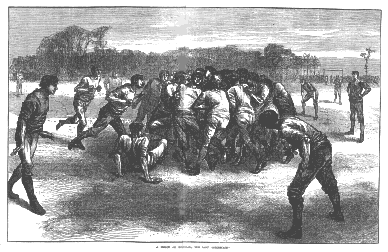
On 4 December 1870, Edwin Ash of Richmond and Benjamin Burns of Blackheath published a letter in The Times suggesting that "those who play the rugby-type game should meet to form a code of practice as various clubs play to rules which differ from others, which makes the game difficult to play." On 26 January 1871 a meeting attended by representatives from 21 clubs was held in London at the Pall Mall Restaurant.
The 21 clubs present at the meeting were: Blackheath (represented by Burns and Frederick Stokes the latter becoming the first captain of England)[4], Richmond, Ravenscourt Park, West Kent,Marlborough Nomads, Wimbledon Hornets, Gipsies, Civil Service, The Law Club, Wellington College, Guy’s Hospital, Flamingoes, Clapham Rovers, Harlequin F.C., King's College Hospital, St Paul's,Queen’s House, Lausanne, Addison, Mohicans, and Belsize Park. The one notable omission was the Wasps. According to one version, a Wasps' representative was sent to attend the meeting, but owing to a misunderstanding, was sent to the wrong venue at the wrong time on the wrong day; another version is that he went to a venue of the same name where, after consuming a number of drinks, he realised his mistake but was too drunk to make his way to the correct venue.
As a result of this meeting the Rugby Football Union (RFU) was founded. Algernon Rutter was elected as the first president of the RFU and Edwin Ash was elected as treasurer. Three lawyers who were Rugby School alumni (Rutter, Holmes and L.J. Maton) drew up the first laws of the game which were approved in June 1871.
Tuesday, November 24, 2009
HISTORY OF RUGBY (Chapter 2)

The schism between the Football Association and Rugby Football
The Football Association (FA) was formed at the Freemason’s Tavern, Great Queen Street, on Lincoln Inn Fields, London, on 26 October 1863, with the intention of framing a code of laws that would embrace the best and most acceptable points of all the various methods of play under the one heading of football. At the beginning of the fourth meeting, attention was drawn to the fact that a number of newspapers had recently published the Cambridge rules of 1863. The Cambridge rules differed from the draft FA rules in two significant areas, namely 'running with the ball' and 'hacking' (kicking an opponent in the shins). The two contentious draft rules were as follows:
IX. A player shall be entitled to run with the ball towards his adversaries' goal if he makes a fair catch, or catches the ball on the first bound; but in case of a fair catch, if he makes his mark he shall not run.
X. If any player shall run with the ball towards his adversaries' goal, any player on the opposite side shall be at liberty to charge, hold, trip or hack him, or to wrest the ball from him, but no player shall be held and hacked at the same time.
X. If any player shall run with the ball towards his adversaries' goal, any player on the opposite side shall be at liberty to charge, hold, trip or hack him, or to wrest the ball from him, but no player shall be held and hacked at the same time.
At the fifth meeting, a motion was proposed that these two rules be expunged from the FA rules. Francis Maule Campbell, a member of the Blackheath Club, argued that hacking is an essential element of "football" and that to eliminate hacking would "do away with all the courage and pluck from the game, and I will be bound over to bring over a lot of Frenchmen who would beat you with a week’s practice".[3] At the sixth meeting, on 8 December, Campbell withdrew the Blackheath Club, explaining that the rules that the FA intended to adopt would destroy the game and all interest in it. Other rugby clubs followed this lead and did not join the Football Association.
Monday, November 23, 2009
HISTORY OF RUGBY (Chapter 1)

Early History
Playing football has been a long tradition in England and versions of football had probably been played at Rugby School for two hundred years before three boys published the first set of written rules in 1845. The rules had always been determined by the pupils and not the masters and they were frequently modified with each new intake. Rules changes, such as the legality of carrying or running with the ball, were often agreed shortly before the commencement of a game. There were thus no formal rules for football during the time William Webb Ellis was at the school (1816–25) and the story of the boy "who with a fine disregard for the rules of football as played in his time, first took the ball in his arms and ran with it" in 1823 is apocryphal. The story first appeared in 1876, some four years after the death of Webb Ellis, and is attributed to a local antiquarian and former Rugbeian Matthew Bloxam. Bloxam was not a contemporary of Webb Ellis and vaguely quoted an unnamed person as informing him of the incident that had supposedly happened 53 years earlier. The story has been dismissed as unlikely since an official investigation by the Old Rugbeian Society in 1895. However, the cup for the Rugby World Cup is named the Webb Ellis trophy in his honour, and a plaque at the school commemorates the "achievement".
Rugby football has strong claims to the world's first and oldest "football club": the Guy's Hospital Football Club, formed in London in 1843, by old boys from Rugby School. Around the anglosphere, a number of other clubs formed to play games based on the Rugby School rules. One of these, Dublin University Football Club, founded in 1854, has arguably become the world's oldest surviving football club in any code. TheBlackheath Rugby Club, in London, founded in 1858 is the oldest surviving non-university/school rugby club. Cheltenham College 1844, Sherborne School 1846 and Durham School 1850 are the oldest documented school's clubs. Francis Crombie and Alexander Crombie introduced rugby into Scotland via Durham School in 1854.
Subscribe to:
Posts (Atom)